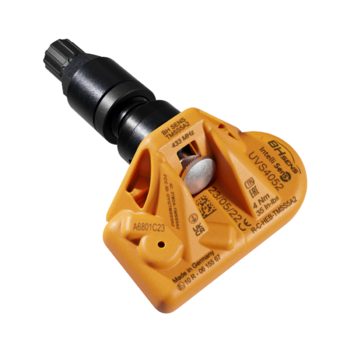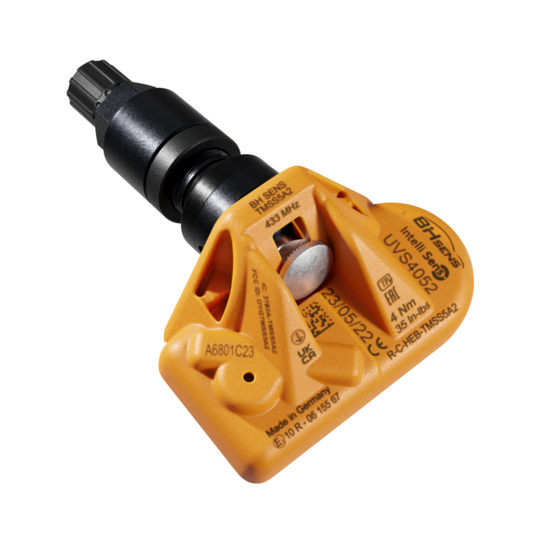


New model of IntelliSens’ high-quality Premium sensor, with even wider vehicle coverage! IntelliSens is the market leader in original equipment tyre pressure sensors.
Advantages of the Premium version compared to the Economy model:
Features:
The IntelliSens TPMS tyre pressure sensor is by far the highest-quality and most comprehensive programmable universal sensor on the market. The sensor covers an impressive 99% of all vehicle models!
IntelliSens also manufactures original tyre pressure sensors for most vehicle manufacturers. This IntelliSens sensor can therefore be used to replace a faulty original sensor, or the sensors can be fitted as an additional set, for example in winter tyres.
Check whether IntelliSens sensors are compatible with your vehicle here.
NOTE! If you would like to order the sensors pre-programmed, please order programming separately. Enter your vehicle’s make, model and year in the comments field.
IntelliSens TPMS sensors can be cloned, in which case no separate programming is needed. Cloning requires the vehicle to be present so that the data can be copied from the sensors currently in use. Sensors programmed by cloning do not require separate adaptation to the vehicle (i.e. driving a certain distance, OBD adaptation or adaptation via the on-board computer).
The steps required to start using new sensors can be found in your vehicle’s owner’s manual.
The sensors can be programmed with programming tools manufactured by ATEQ, which can also be ordered from us.
Installing the sensor
Use a torque wrench set to 4.0 Nm for installation. Make sure the sensor is in contact with the rim along its entire length so that it is fitted correctly.
Tighten the nut with the torque wrench in a smooth, continuous motion. At approximately 3.0 Nm, the movement will slow down until the plastic collar breaks off. Continue tightening to the final torque of 4.0 Nm.
NOTE! Do not remove the plastic collar from the valve before installation!
Legislation
Tyre Pressure Monitoring Systems (TPMS) became mandatory in the EU under Regulation (EC) No 661/2009. The requirement applied to new passenger cars type-approved from November 2012 and to all new passenger cars registered for the first time from November 2014. Since July 2022, the requirement has been based on the General Safety Regulation (EU) 2019/2144, which replaced the earlier regulation and gradually extended the requirement to other vehicle categories, such as light commercial vehicles. The EU requirement applies to new vehicles at the time of type approval and first registration.
Although it is not mandatory to fit sensors to additional tyre sets, and the system can even be switched off, using the system is still recommended. The system monitors tyre pressures and thereby reduces vehicle emissions and additional costs while improving safety.
How does a TPMS system work?
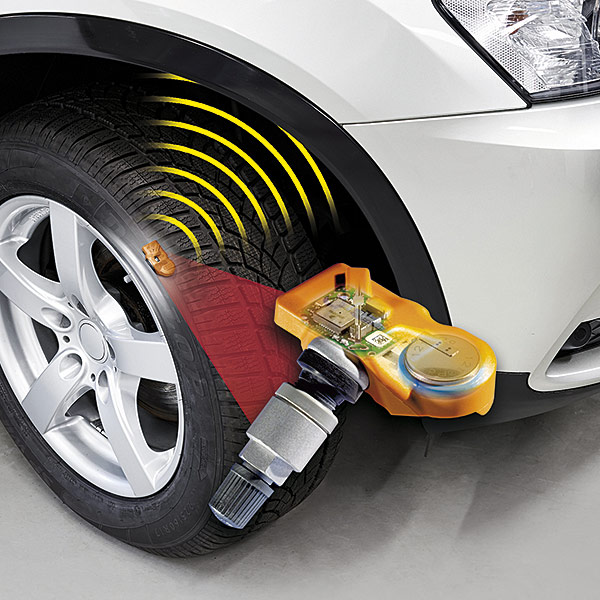
Tyre pressures can be monitored with either a direct (active) or an indirect (passive) system. In an active TPMS system, a sensor fitted inside the tyre directly measures the tyre’s pressure and temperature. A passive system, on the other hand, only detects the change in the tyre’s rotational speed caused by a drop in pressure. Both systems must warn the driver with a TPMS warning light on the dashboard at the latest when the pressure in an individual tyre has dropped by 20% from the recommended tyre pressure or below 150 kPa (1.5 bar), whichever limit is reached first.
Identifying new pressure sensors
For the vehicle to recognise the new sensors and for the TPMS warning light to go out, the vehicle must perform a so-called relearn procedure. The most common methods are:
Benefits
TPMS systems and maintaining the correct tyre pressure have a major impact on driving safety and fuel economy.
Safety
Correct tyre pressure ensures the best possible tyre performance. When the tyre pressure is correct, the tyre rolls easily and steers precisely. Incorrect tyre pressure reduces the tyre’s grip, which, for example, increases braking distances and the risk of aquaplaning.
Tyre life
Tyre pressure that is too low shortens the tyre’s service life. When the tyre pressure is too low, the tyre wears faster and heats up more, its durability decreases and, for example, the risk of tyre failure increases.
Fuel consumption
When the tyre pressure is too low, the tyre’s rolling resistance is higher, so more energy is needed to keep it rolling. This means that fuel consumption increases.